
✨ Your Manifestation Routine Isn’t Working? Stop Forcing It.
Oct 28, 2026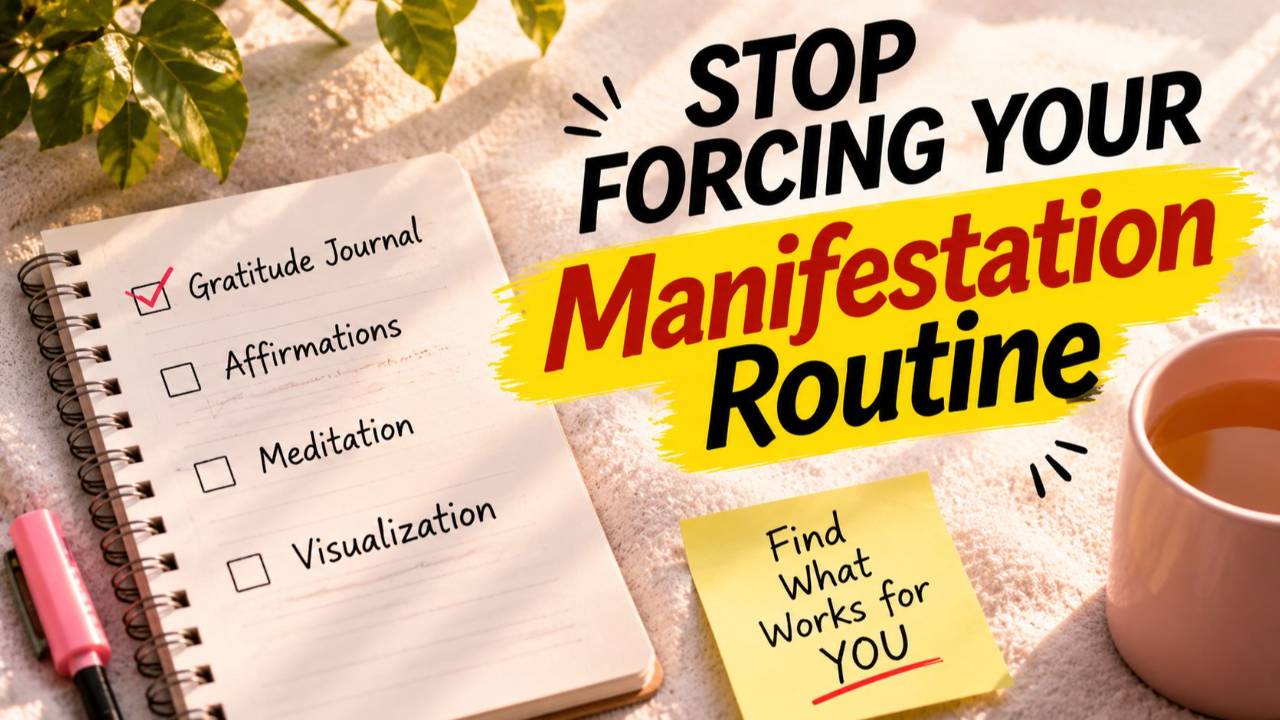
You don’t need to become a perfectly disciplined person to practise manifestation. You need to find a method that works for you—and turn your intentions into action.
Have you ever started a gratitude journal with incredible excitement? 📔
You bought the journal, made your first few entries, and promised yourself you would continue every morning.
Day 1: Done! ✅
Day 2: Done! ✅
Day 3: Still going strong! 💪
Then life happened.
You missed a day, then another. A few weeks later, your journal was sitting under your bed, and you were wondering why you couldn’t stick to something you genuinely wanted to do.
Perhaps you even told yourself, “I’m just not disciplined enough.”
But what if the problem isn’t your discipline?
What if you’re simply trying to follow a routine that doesn’t work for you? 🤔
Your manifestation practice should help you move closer to your dreams—not become another reason to criticise yourself.
Let’s explore five practical ways to make your manifestation routine more engaging, flexible, and action-oriented. 🌟
1. Stop Confusing Consistency With Repetition 🔄
Traditional manifestation advice often sounds straightforward:
-
Write your affirmations every morning.
-
Maintain a gratitude journal.
-
Meditate at the same time every day.
-
Repeat your routine until it becomes a habit.
These practices can be valuable. But not every technique works equally well for every person.
Some people love journaling. Others find it tedious after a few days. Some enjoy quiet visualisation, while others connect more easily with their dreams through music, movement, images, or conversation.
When a method stops engaging you, forcing yourself to continue isn’t always the most useful response.
Think about running in shoes that don’t fit. You could force yourself to keep running, but finding shoes that fit better would make much more sense. 👟
Your personal growth practice deserves the same consideration.
Instead of concluding that you’re incapable of consistency, experiment with different approaches.
Perhaps you don’t need to abandon your goal. Perhaps you need to change how you pursue it.
Consistency doesn’t always mean repeating the same activity. It can mean returning to the same intention through different practices.
Remember: Difficulty maintaining a routine does not automatically mean you have ADHD. These suggestions are personal development exercises, not ADHD treatment. If you have concerns about ADHD, consult a qualified healthcare professional.
2. Use Your Curiosity to Explore One Dream Deeply 💫
Have you ever become so interested in something that you completely lost track of time?
Perhaps you researched a holiday destination for hours, explored a fascinating subject, or became absorbed in an exciting new idea.
That curiosity can be a useful starting point for your manifestation practice.
Instead of trying to visualise ten different dreams in one sitting, choose one goal that genuinely excites you.
Give yourself 20 minutes to explore it.
✈️ Want to visit Switzerland?
Explore the mountains, look at possible destinations, and imagine the experience you would love to have.
💼 Want to start a business?
Explore the problem you want to solve, the product you could create, and the people you want to help.
🚀 Want to change careers?
Research the skills you need and imagine yourself growing into your desired role.
Don’t turn this exercise into another obligation. Allow yourself to enjoy exploring the possibility.
Then, before you finish, ask yourself one important question:
“What is one practical step I can take towards this goal?”
You might research the cost of your trip, outline your business idea, or spend ten minutes learning a new skill.
Your imagination can help you clarify what excites you. Your next action gives that excitement somewhere practical to go. 🎯
3. Acknowledge Your Emotions Without Letting Them Define Your Future 💛
Our emotions can influence how we approach our goals.
When you’re excited, a possibility may feel achievable. When you’re frustrated or disappointed, that same goal may suddenly seem impossible.
The answer isn’t to pretend difficult emotions don’t exist or force yourself to feel positive all the time.
Instead, practise noticing your emotions without automatically treating every thought as a fact.
Imagine you make a mistake and immediately think:
“I’ll never be good at this.”
Pause for a moment. Breathe. Acknowledge that you’re frustrated.
Then ask yourself:
“Is this a complete picture of the situation, or am I reacting to how I feel right now?”
You could also recall a time when you handled a difficult situation, achieved something meaningful, or received encouragement from someone you trust.
Let that memory remind you that one difficult moment doesn’t define your entire ability.
You can feel disappointed and still believe improvement is possible.
You can experience uncertainty and still take the next step.
You can acknowledge your current reality without deciding that your future must look exactly the same.
🌱 The goal isn’t to eliminate negative emotions. It’s to stop allowing one difficult moment to decide what you believe is possible.
4. Rotate Your Manifestation Techniques Instead of Abandoning Your Goal 🔄
Imagine you want to practise manifestation consistently, but journaling becomes boring after a few days.
Instead of deciding you’ve failed, try changing the format.
Here’s one way to experiment with different techniques over four weeks:
Week 1: Vision board 🎨
Collect images and words that represent your goals. Arrange them in a way that feels meaningful to you.
Week 2: Gratitude 🙏
Write down a few things you appreciate. They don’t have to be extraordinary achievements. Ordinary moments count, too.
Week 3: Affirmations 💬
Choose affirmations that reflect the qualities you want to develop or the direction you’re working towards.
Week 4: Visualisation 🌈
Spend a few minutes imagining yourself pursuing a goal, navigating challenges, and taking the actions needed to move forward.
You can adjust this rotation to suit your preferences. You don’t need to wait an entire week to change methods if another approach would help you engage more comfortably.
The important thing is to keep your underlying intention clear.
For example, if your goal is to become more confident, you could practise confidence through journaling one day, affirmations another day, and taking a courageous action the next.
The technique can change while your goal remains the same.
You aren’t starting over every time you try something different. You’re experimenting to discover what helps you stay engaged.
5. Turn Inspiration Into Action Within Five Minutes ⚡
This may be the most practical technique of all.
Have you ever had a brilliant idea, felt incredibly excited, and then spent weeks thinking about it without doing anything?
You imagined the possibilities. You considered what could go wrong. You wondered what other people would think.
Eventually, the initial excitement faded.
One way to interrupt this pattern is to connect inspiration with a small, immediate action.
Whenever an idea genuinely moves you towards a goal, ask yourself:
“What is one useful thing I can do in the next five minutes?”
Here are a few examples:
💼 Want a new job? Open your résumé and improve two lines.
🚀 Want to start a business? Write down the problem your first product could solve.
🚶 Want to improve your health? Put on your walking shoes and take a short walk, if appropriate for your health and circumstances.
📚 Want to develop a new skill? Open the lesson you’ve been postponing and begin.
The action doesn’t need to be impressive. It needs to be manageable.
And remember, acting on inspiration doesn’t mean making impulsive purchases, taking financial risks, or committing to major decisions simply because you feel excited.
Start with a small, reversible step.
You don’t need to complete the entire journey while your motivation is high. You just need to make beginning easier.
Over time, small actions can help you build momentum towards your goals. 🌟
Your Manifestation Practice Should Help You Move Forward 💫
Let’s bring these ideas together.
✨ Explore one goal deeply.
💛 Learn to acknowledge your emotions without treating every thought as a fact.
🎨 Experiment with different manifestation techniques.
⚡ When inspiration arrives, take one small, practical step.
None of these approaches requires you to become a perfectly organised person overnight.
You don’t need to feel motivated every morning. You don’t need a flawless routine. And you don’t need to turn personal growth into another reason to criticise yourself.
Instead, experiment.
Notice which practices engage you. Make them manageable. Adapt them when necessary.
Most importantly, remember that manifestation is not a substitute for planning, skill development, professional support, or action in the real world.
Use visualisation to clarify a goal. Use affirmations to reinforce an intention. Use daily practices to remind yourself of what matters.
Then give that intention room to become action.
Stop spending all your energy trying to become someone who follows the perfect routine. Start building a practice that helps you take the next step. ❤️
🌟 Ready to Deepen Your Manifestation Practice?
If you’re ready to explore your personal growth journey with more structure, discover Platinum Membership.
Explore the programme here:
👉 https://coaching.miteshkhatri.com/platinum-membership-intro-aevent?el=BlogPLAT281026
💬 Let’s Talk!
Which manifestation technique is hardest for you to stick with—gratitude journaling, affirmations, meditation, or visualisation?
And what helps you return to it when you lose momentum?
Share your experience in the comments. Your insight might help someone else discover an approach that works better for them.
SEO Details
SEO Title: Manifestation Routine Not Working? Try These 5 Practical Tips
Meta Description: Struggling to maintain your manifestation routine? Discover five practical ways to personalise your practice, build consistency, and turn intentions into action.
URL Slug: manifestation-routine-not-working
SEO Tags: Manifestation, Manifestation Techniques, Personal Growth, Gratitude Practice, Affirmations, Visualisation, Mindset, Goal Setting, Daily Habits, Self-Development
